Addiction: Compulsive dependence on a substance or habit.
Addicere (Latin): To deliver, award, devote, consecrate, or sacrifice.
Addictum (Latin): Having been assigned or given over as a debt slave to a master.
The Scroll Hole
To walk the casino floor of a Las Vegas cathedral is to be baptized in the hazy spirit of compulsion.
Humans sit welded to slot machines. Vacant stares. Blood shot eyes. Trapped in a variable reward trance.
These are the lost souls disassociating in the dopamine desert.
With precise instruments of psychological manipulation, the calculated machines hack into their stone age human hardware. Brains built for hunting and gathering now pursue only the machinations of their masters.
With algorithmic efficiency and cold indifference, money and attention are extracted from the zombified masses.
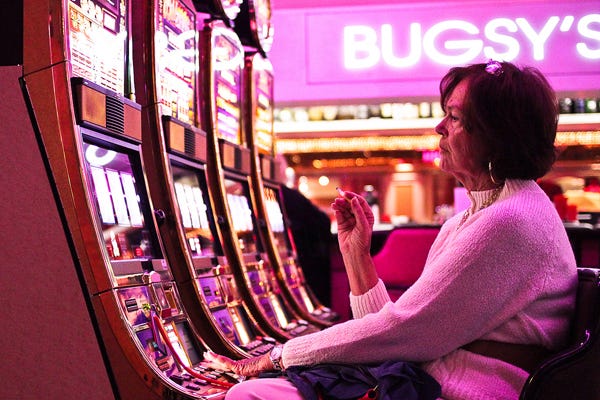
Here in Vegas, we have a very special word for this slow demise into brain rot and depravity: “gaming.”
Of course, we wouldn’t want to be so honest as to call it gambling. That’s a bit too real for the marketing department.
“Come and gamble! You MIGHT win some money… and you might lose your soul.”
Instead, “players” are “gaming,” chain-smoking cigarettes and drinking their “free” booze in between the intermittent hits of slot-dopamine. The masters strategically place that next variable reward just around the corner, just beyond that next deposit of cash, just one more spin away.
And so they “play” on, as their vacations (and lives) slowly slip away.
So effective is this technology of psychological parasitism, that it literally built Las Vegas. Billions of dollars and innumerable hours were leeched from the body of humanity, feeding the corporate cathedrals.
For decades, Las Vegas swallowed attention, extracted money, and consumed souls around the clock—24/7, 365.
Although tragic, the machinations of the masters were mainly quarantined to the desert. You could simply avoid going to Vegas.
But then, around 2013, something terrifying and unexpected happened.
The masters evolved. They became mobile.
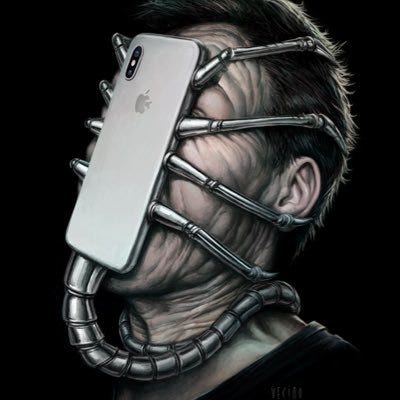
The casino moved into your pocket.
Nomophobia (no mobile phone phobia):
The anxiety or fear one feels when separated from one’s mobile phone or without mobile connectivity (dead battery, no service, etc).
Physical Symptoms:
Trembling, sweating, rapid heartbeat (tachycardia), breathing changes, agitation.
Emotional Symptoms:
Panic, disorientation, irritability, compulsive phone-checking.
Chances are you’re looking into it now: that small glowing screen, promising everything. That familiar companion who follows you everywhere, buzzing in your pocket when you’ve been away for a few minutes.
You are consecrated to your phone. You feel naked and vulnerable without it.
For the masters offer everything.
Answers to all your questions. Limitless novelty. Unbounded information. All perfectly curated your particular preferences.
The ultimate weapon of psychological manipulation, algorithmically fine-tuned to extract your life force and convert it into dollars.
The masters pulled it off: they shrunk the casino into the palm of your hand.
Now billions of hungry ghosts scroll through a digital abyss, anticipating that next hit.
That next piece of content.
That next variable reward.
And so humanity fell, deeper and deeper into the scroll hole
Peak Screen Time
The average American spends 7 hours per day on screens.
Gen Z is even worse, sacrificing about 9 hours per day to the machines.
A simple (and depressing) back of the napkin calculation shows that we are spending about 1/3 (!!!) of our lives staring into screens—roughly 3000 hours per year.
That one hurts if you really let it sink in.
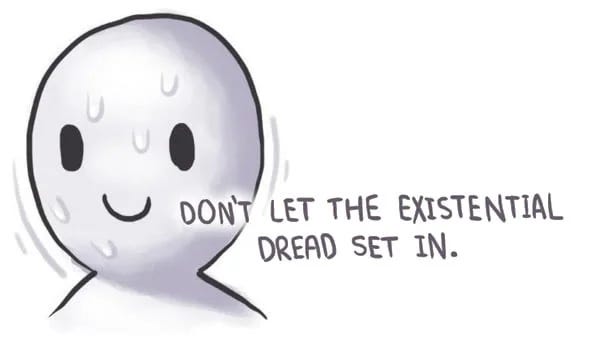
1/3 of your life for sleeping. 1/3 for scrolling. 1/3 for eating, pooping, and drowning in the existential dread that floods in when you realize this is your life.
So is there any hope?
Well, the good news is that many of us have already hit peak screen time.
Many of us peaked during the pandemic, when all of our lives involuntarily moved online. After our nervous systems were bathed in a two year long COVID cluster-fuck, many of us woke up and started shifting our relationship to screens.
And it seems to me like the cat is out of the bag. Too many people are defecting and speaking out against the masters. Too many people are over it.
Films like the Social Dilemma have gone viral and shifted public perspectives about social media and technology.
Multiple studies across multiple age groups show a connection between increased screen time and depression, anxiety, and overall lower wellbeing.
But we don’t need scientific studies to validate our own lived experience. Not so deep down, we know how shitty we feel after falling into the scroll hole. Extended periods of screen time leave us dopamine drained and attention fatigued.
This is why terms like doom-scrolling are common. Everyone gets what’s going on. It’s not rocket science.
We all know that its gambling, not gaming. We know that what we spend 1/3 of our lives on is not a “phone.”
Everyone is hopelessly addicted to a novelty engine that also happens to make phone calls.
We just live in a society that normalizes the indentured servitude of being owned by a “phone.”
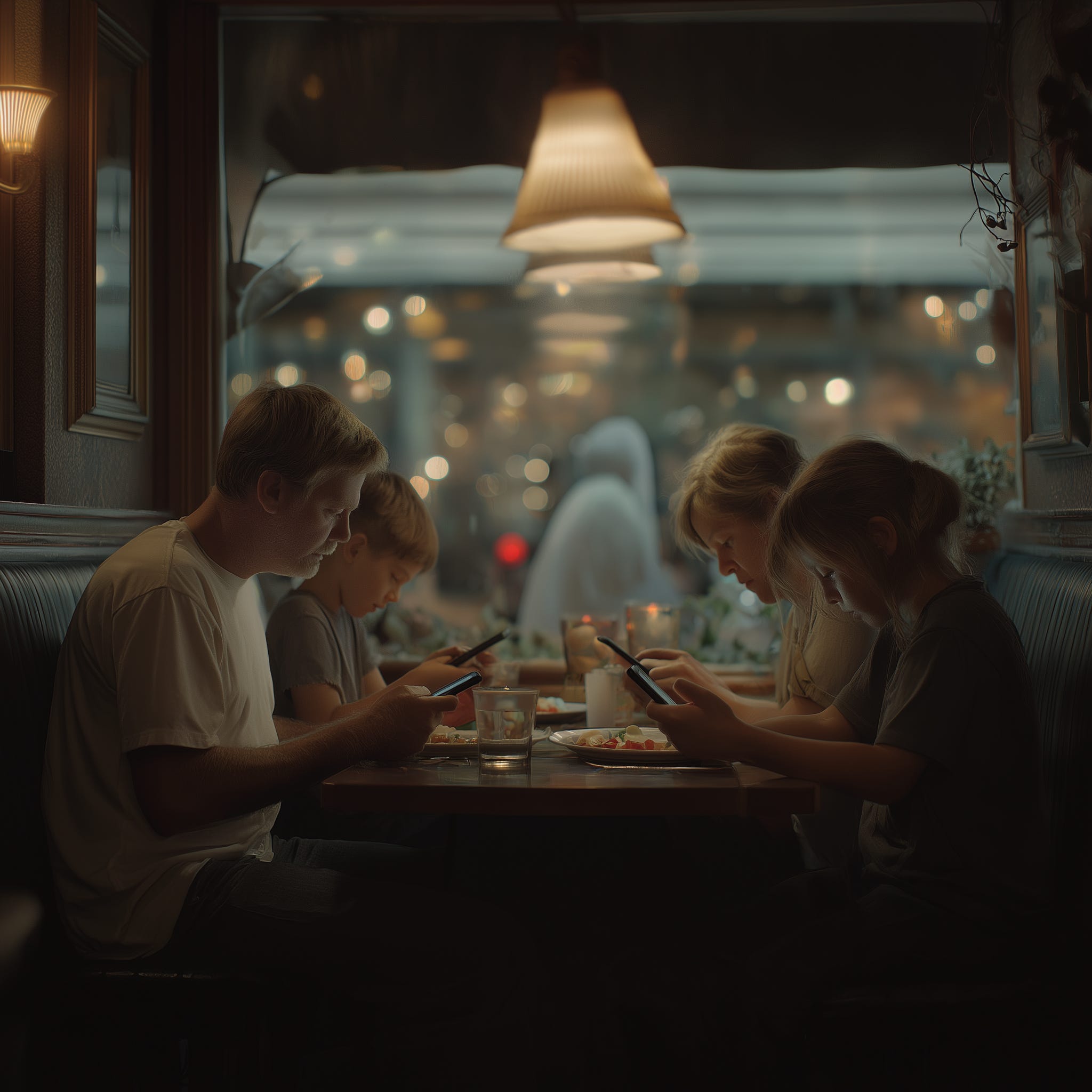
That normalizes an entire family staring into screens around the dinner table instead of talking to each other and sharing a meal together.
That normalizes the digitization of everything, the commodification of attention, and the alienation of humanity.
That normalizes our nomophobia and our intimacy disorder.
But some of us have already hit rock bottom of the scroll hole. Like a gambling addict coming to their senses at the ATM, we left the horde of screen zombies.
We’ve snapped out of the trance and mustered up the courage to look in the settings and take inventory of our digital addiction.
We’ve reconciled the cost of worshiping at the alters of Facebook, Youtube, Instagram, TikTok, and X.
We’ve seen the daily averages akin to a full time job of scrolling.
We’ve hit peak screen time, and we are fucking over it.
Attention Sovereignty & The New Punks
Over the centuries, the punks have questioned the mainstream and lead a counter cultural revolution.
From the dark age shadows of secret societies, to the peace marches of the hippy 60’s, the punks have stood against the oppressive status quo.
Science began as a revolution against the orthodoxy of the church. Dr. King’s civil rights movement was a revolution against racism and a white ruling class. Silent Spring and the environmental movement sparked a revolution against ecocide and the destruction of nature.
But now the new punk revolution has arrived, and it’s more fundamental than all the movements before it.
It’s a revolution to reclaim our sovereign attention.
“The most precious resource we have is not time, it’s attention.”
—Tristan Harris, The Center for Humane Technology
The new film ‘Good Luck, Have Fun, Don’t Die’ (must watch) suggests that the revolution is beginning to go mainstream. The collective is waking up from the digital dream.
Attention is our most valuable, and most scarce resource. You have a finite amount of time on this earth, and what you focus your attention on is how you “spend” that time.
All the tyrants of human history could have never imagined our current state of affairs. Never before was it possible to hijack the attention of entire populations. Not even the most powerful emperors could capture and control the minds of virtually everyone. Our current information age of hyper-normal stimuli and algorithmically constructed reality are the things tyrant’s dreams are made of.
This revolution is about reclaiming YOUR attention—your sovereign mind and your precious time is sacred.
And if that’s not reason enough for you to take action, let me try another approach.
“The mass of men live lives of quiet desperation.” —Henry David Thoreau
This is me reaching through the screen and shaking you by the shoulders, screaming:
WAKE THE FUCK UP!
This isn’t gaming. This is gambling life away. 1/3 of our lives sacrificed to screens.
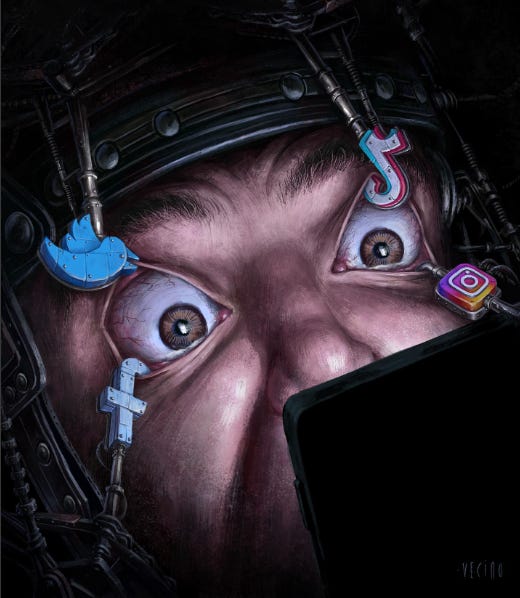
The machines are winning. The tech overlords are winning. Our lives are draining out through bloodshot eyes and into the black abyss of the scroll hole.
Enough is enough.
Are you done sacrificing sovereignty for dopaminergic distractions?
Are you done mortgaging your mind to the tech overlords?
Are you ready to put up a fucking fight?!
If you’re still reading this, you’re probably one of the punks I’m talking about.
If so, you can consider me the herald calling you to revolution.
I’m challenging you to take a fearless inventory of your digital addiction and break the cycle.
Welcome to the new punk scene
We are human, not machine!
Awaken from this digital dream
The 30-Day Digital Detox
During the pandemic, my screen time was way up, just like everyone else.
But like many others during those crazy couple of years, I began to truly realize how negative of an effect technology was having on my life.
So, I changed it. It was difficult at first, but over time I got better and better at navigating my relationship to screens.
I used to spend roughly 5 hours per day on my iphone, now I average less than 2. I’ve reclaimed about 3 hours per day of my attention, saving roughly 1000 hours per year.
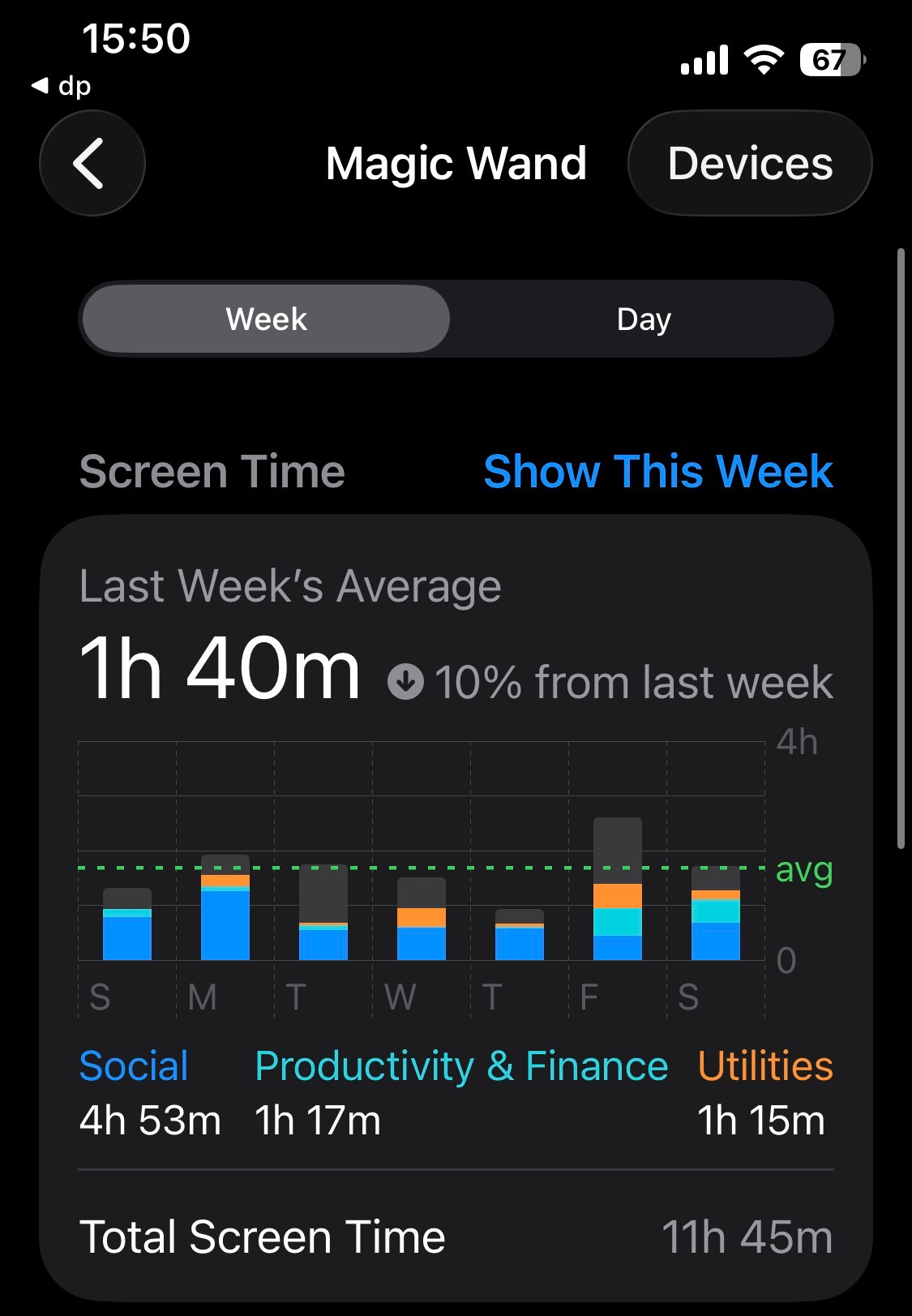
That’s enough time to start a side business, pickup an instrument, or make memories with your kids.
As I don’t have kids yet, I’ve spent most of that time learning, and I want to share with you some of the fruits of that journey.
So I’m launching a course—The 30 Day Digital Detox.
Structured as a 30 day challenge and hosted right here on Substack, this course is grounded in both cutting edge research and my personal journey out of the scroll hole.
This 30-Day Digital Detox is also offered in collaboration with Jamie Wheal and The Flow Genome Project.
I have been learning and training with FGP for the last few years, and have recently joined their team. This course effectively functions as a primer and foundation for our other trainings.
Here’s what’s inside:

Part 1: Own Your Phone
Stop the bleeding and transform your relationship with your “phone.”
Benefits: Defeat digital addiction, end brain rot, and reclaim 1000 hours per year.
Actions: Implement the DELETE protocol, become a digital minimalist, and transform your phone from a casino back into a useful tool.
Foundations: Atomic Habits by James Clear, Digital Minimalism by Cal Newport, Your Stone Age Brain in the Screen Age by Richard Cytowic.

Part 2: Train Your Brain
Un-fuck your nervous system and build a foundation for vital living in the modern age.
Benefits: Improve sleep, boost energy, and increase focus
Actions: Reset your nervous system, go on a light diet, craft morning and evening rituals.
Foundations: Why We Sleep by Matthew Walker, The Sleep Toolkit & Optimal Morning Routine by Andrew Huberman, The Book of Floating by Michael Hutchison
Part 3: Mind Your Time
Funnel your newfound energy, focus, and time into what matters most.
Benefits: Get shit done, experience more flow, create a meaningful life
Actions: Protect deep focus time, consume slow media, design your calendar.
Foundations: Deep Work by Cal Newport, The Flow Genome Project and the work of Jamie Wheal, The Four Hour Work Week by Tim Ferris
It’s time to take the power back.
As you can probably tell by now, I am quite passionate about this revolution. I understand the stakes, not just for each of us individually, but for our world as a whole.
What is the cost of doing nothing?
It’s not just more fatigue, brain fog, and disrupted sleep.
It’s not just more depression, anxiety, and nomophobia.
It’s not just more ADHD, virtual autism, and digital dementia.
The cost is children raised by algorithms, relationships sold as a subscription, and our very humanity being extracted by machines.
I see this work as essential, not optional. Nobody ever taught us the basics of navigating a world of screens and perverse incentives. This knowledge should be ubiquitous and mandatory learning for anyone navigating the modern age.
Up to this point, all of my posts have been made public and available to read for free. But I’ve decided to make this course only available for paid subscribers. Here are the three reasons why:
Time
It’s taken me years of learning and practice to hone this in, not to mention dozens of hours to actually create the course. Plus I’m starting a family and gotta bring home that proverbial bacon. So your support is huge!Value
If you actually complete the challenge, you’ll save about 1000 hours per year (based on average numbers). Even if you only valued your time at minimum wage ($7.25/hour), that’s over $7K in value reclaimed, per year. But obviously the actual value of reclaiming attention sovereignty is priceless.Effort
Without skin in the game, you won’t take it seriously. This is proven true across the online course world, fitness space, and everywhere that performance and effort are required to get results. The data suggests that paying is essential if you plan to actually benefit and not just add another nice idea to the shelf of someday.
All that said, I really do see this as necessary work for everyone, and if you truly aren’t able to afford a paid subscription, simply send me an email or a message here on Substack and I will give you access.
The 30-Day Digital Detox will be dropping over the next month. I hope you’ll join me on this quest to own your phone, train your brain, and mind your time.
Stay curious,
Christian
Las Vegas
26/02/2026
P.S. This post was not written with AI. I do use AI for research (Perplexity) and sometimes images (Midjourney), but the words come from me. It costs a lot more calories that way so thank you for supporting my work.