

Welcome to a Christian Epiphany.
This post is equal parts soulful storytelling, heartfelt testimony-bearing, and unapologetic apostatizing.
For the skeptics, here is reason. For the seekers, here’s a map. For the faithful, here be dragons. 🐉
Hi. I’m Christian.
Not only was I raised to be a good Christian, but I was literally named Christian.
I was born in 1992 to good Christian parents, educated at a private Christian school, and indoctrinated by a fundamentalist Christian church. Additionally, I was shaped by a Christian sub-culture (Fundamentalist Utah Mormonism), within a larger Christian nation (USA), as part of a global Christian paradigm (The West).
That’s a shit ton of Christian. Some might say, too much Christian. All my easter-eggs were in the Christian basket.
So you can imagine the Biblical proportions of my existential atonement, when my conviction in Christianity was crucified, and there was no way to salvage my salvation.
I lost my testimony in my savior, and entered the long dark night of the soul.
“Jesus Christ, I’m alone again
So what did you do those three days you were dead? ‘
Cause this problem is gonna last More than the weekend”
—Brand New, Jesus Christ
I was at a real CROSSroads, but little did I know it was the beginning of a 13 year odyssey that would transform me, culminating in my own resurrection (in the Campbellian sense).
Now, coming full circle, I’ve returned to the Christian story, with fresh eyes, radical hope, and a boon for my people.
“We shall not cease from exploration, and the end of all our exploring will be to arrive where we started and know the place for the first time”
—T.S. Eliot
The prodigal’s son has returned.
I’ve been born again in Christ. Redeemed!
Christian can finally say he’s Christian again. It’s a Christmas miracle!
BUT…
Before all of my Christian homies go singing hallelujahs, and praising Jesus, you might wanna wait for the punch line.
You see, there’s a bit of a twist in this road to Damascus story…
You can call it heresy, modern revelation, or simply common sense, I don’t really care. But it’s time to update the Christian code.
Over the last two thousand years, countless witches, sages, and mystics have been tortured and murdered for saying what I’m about to tell you. They paid the highest price for speaking their truth.
But here we are, in the modern era of (somewhat) free speech, where we’ve swapped public executions for cancel culture.
So you’ll have to throw those stones in the comments. 😉
Exodus
I left fundamentalist Mormonism when I was 20 years old. For those who don’t know, Mormons are absolutely Christians. After all, the official name of the church Joseph Smith started is: The Church of Jesus Christ of Latter Day Saints.
The exact moment of my faith crisis occurred when I read the CES letter back in 2012. My faith in Joseph Smith wholly ghosted me, never to be seen again. Maybe that means I was never really a true believer, or maybe it was simply the first time I had genuinely considered ANY alternative to the standard Mormon narrative that had been seared into my brain since before I could speak english.
If you’re Mormon, decide for yourself: you can read My Mormon Story here.
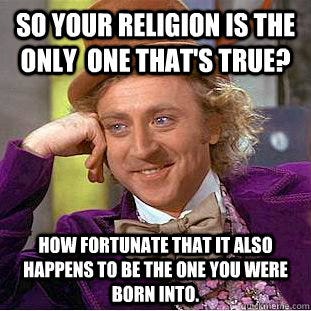
After I lost my testimony in Mormonism, I spent the rest of my 20’s running from my Christian roots. In other words, I was ontologically uprooted, cast out of my Father’s kingdom to drift like an existential tumble weed in the wastelands of Las Vegas.
My safety and assurance in Jesus as “Lord and Savior” gave way to a kind of numbed out nihilism, as I discarded all religion from my life.
Of course I didn’t realize at the time that you can’t actually fully discard religion. As the late great scholar of religion Mircea Eliade once said:
“To whatever degree he may have desacralized the world, the man who has made his choice in favor of a profane life never succeeds in completely doing away with religious behavior.”
―Mircea Eliade, The Sacred and the Profane: The Nature of Religion
Humans worship, and there really isn’t any way around it. So naturally other “gods” filled that Jesus-sized whole in my heart.
I put my faith in capitalism, zealously chasing money like my soul depended on it. I religiously attended the church of the NFL on Sundays, screaming at the TV whenever my sacred team was defeated by the forces of evil (The Patriots). And of course I gladly over-consumed the sacraments of the Great American CULTure (sugar, booze, & screens) until I was fat, addicted, and depressed.
But then, something miraculous happened in 2017.
Inflamed, anxious, and desperate for change, I went walking down an electric avenue (Electric Daisy Carnival). I ate some MDMA (ecstasy) and about 2 hours later the good Lord appeared, blasting my heart chakra wide open, and causing me to weep tears of joy for existence itself.
My insecurities melted away, my shirt came off, and I began dishing out bare-chested, teary-eyed, sweat-bombs (pudgy rave hugs) to total strangers, as if they were loaves and fishes.
As I PLUR-ed the night away, something came alive in me that had long been forgotten—an inner child with the wisdom to walk on the proverbial waters of unconditional love.
I had risen… or at least my serotonin levels had.
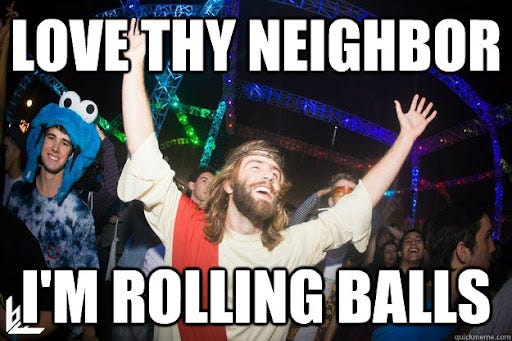
My molly miracle would lead to further soul-seeking via meditation, yoga, psychedelics, and sensory-deprivation (in float tanks). And, as tends to happen when one goes deep in the tank, I blew up my life and began shedding my old skin.
I quit my job to wander the earth, earnestly seeking wisdom from wherever I could find it.
This was the birth of True North Project.
The Christian Story
So what even is a Christian?
Let’s unpack this loaded term before we go any further.
Christian was the first word I remember writing in squiggly crayon. My early ego was formed atop the bedrock of the Christian story. Even before I had a full grasp of english, the story of Jesus was seeded in my brain.
Here is a super short, super simple summary of that story:
Jesus Christ is the ONLY begotten Son of God, and his crucifixion and atonement (human sacrifice) redeemed the world of it’s brokenness (original sin). The highest purpose and meaning of your life is to accept Jesus as your Lord and Savior, strive to be like Him, and be saved.
So in the mainstream sense,
A Christian is one who is saved by Jesus the Christ.
This simple definition has created quite the gulf between the saved and the unsaved, and is the reason why I’m the “black sheep” in a fundamentalist flock of 24 children.
I’m the sheep that got away. The heretic who turned his back on Jesus, on the gospel, on “The Work” of my salvation.
I’m the thorn in my parents side, influencing my younger siblings with my heresies and risking their salvation as well.
I’m the uncomfortable conversation at the dinner table, always asking the awkward questions that don’t have easy answers.
I’m the awkward hug/handshake you give to your wayward brother who’s lost the plot and who’s soul is on a course to outer darkness, where there will be weeping, wailing, and gnashing of teeth (for all eternity).
Ironically (and somewhat poetically) I’ve spent roughly 1000 hours in sensory deprivation tanks, floating blissfully in outer darkness. Rather than wailing and endlessly grinding my teeth (MDMA floats notwithstanding), I’ve quite enjoyed it.
In fact, in outer darkness I seem to have found the inner light.
You see, light and dark go together. Yin and Yang. Black and White. On and Off. These universal polarities belong to the same spectrum. To toss one end of the poll out is both impossible and pathological.

Making the dark the place of evil, satan, weeping, and sore teeth, is a bit childish isn’t it? Like, when did we become a culture of people terrified of their own shadows?
But I digress, and I’m getting a little ahead of myself.
So… if I’m claiming to be been born again in Christ, why would I be considered a heretic who’s ultimate fate involves crying in the dark forever?
To climb past the crux of this millennia-old priestly problem, we have to distinguish between two separate concepts:
Jesus of Nazareth - the man, the myth, the legend.
Christ (Greek Christos) - “the anointed one,” the Son of God.
For most modern Christians, these concepts are one and the same, and that’s precisely what’s at the core of our collective existential cluster-fuck. It’s why for more than a thousand years we’ve burned the blasphemers, hanged the heathens, and tortured those transgressors of the ONE TRUE gospel.
It’s honestly been a brutally dark road we’ve walked through the Piscine Age. We’re only now just beginning to collectively process the religious war, torture, murder, and genocide, often done in the name of Christ.
So full permission to get messy as we take that Jesus story down from the dusty shelf labeled “just have faith.”
Jesus! That’s a lot of Christians
There are roughly 2.4 billion Christians in the world today. That’s 31% of the global population!
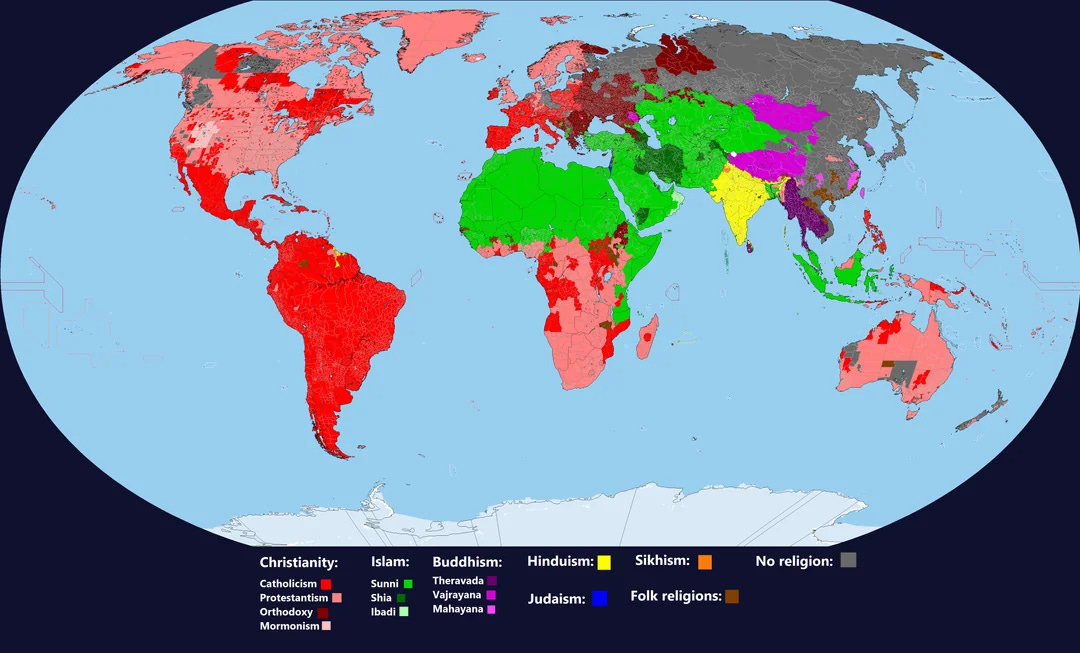
How did this religious meme spread to inhabit the minds of 1/3 of the planet?
The answer is quite complicated, and beyond the scope of this post. But fuck it, let’s sum it up in a single word: Rome.
Rome forcefully converted its subjects to Christianity after Constantine came into power. The Holy Roman Empire conquered just about all of their neighbors, and thus the Western mind was built on the foundation of a very particular flavor of Christianity. And, as they say, the rest is history.
Jesus however, is a figure shrouded in mystery. After all, the dude lived 2K years ago and the oldest writings we have about him were 2nd and 3rd hand accounts, all of which were recorded decades to centuries after his death.
So who was this Nazarene that dropped dank downloads and sent ripples through the millennia?
There are MANY diverse perspectives about Jesus, and many answers to this question. So lets observe the story through a few different lenses to try and get our heads around it.
But first, a quick word about lenses. 🤓
John Vervaeke is a cognitive scientist that knows a thing or two about how we humans do this whole human thing, including how we make sense of our world and “know things.”
Vervaeke has coined the term relevance realization, the notion that our minds have a built-in skill for zeroing in on “what matters” amidst the endless sea of possibilities. We filter out most of reality, decide (somewhat unconsciously) what to pay attention to, and then subscribe to it a meaning.
Therefore, you might define “the sacred” as what we deem to be MOST relevant, and therefore meaningful.
Taken a step further, this process of relevance realization ultimately culminates in a worldview, or a weltanschauung as the Germans call it. We take the most relevant bits and build a story about the universe and our place in it.
To use John’s metaphor, we see the world through lenses. These lenses bend the “light” of reality to fit into our worldview, crafted throughout our lifetimes by our language, the dominant paradigm of our culture, and our core cosmological stories, just to name a few.
What I am inviting you to do, dear reader, is to try and take your lenses off—just for a few minutes—to see them for what they are. Don’t worry, after inspecting the lenses, you can put them back on and go right back to seeing through them as before, if you choose.
If you find yourself getting triggered as you read further, chances are you’re looking THROUGH the lenses, rather than AT the lenses.
#killthosesacredcows
Ok, now back to our regular Christian programming.
Let’s look at this story through three primary lenses: The Messiah, The Christ, and The Trinity.
The Messiah - Jesus the Jewish Revolutionary
This first lens tries to get a grasp on the historical Jesus. Its primarily a secular perspective that grapples with the man himself, rather than dealing with “mythical Jesus” or Jesus the Christ—a term given to Jesus by Paul long after his crucifixion.
In 63 BCE, Judea was conquered and occupied by Rome. Jesus was born into a time of tension, rebellion, and ultimately war. Roman rule was fierce, taxes to Caesar were mandatory, and crucifixion was the price paid for sedition.
In fact, Rome adopted the cross in the 3rd century BCE as a brutally public torture/execution method for subduing occupied populations. When the road you walk on your daily commute is lined by crucified rebels, you tend to get the message pretty loud and clear: “This is what happens when you disobey Roman rule.”
On the other hand, the Kingdom of Israel was a theocracy, and true believers in Jewish law despised having to bend the knee to Caesar. They saw God’s law (as laid out in the Hebrew Bible) as the supreme and only commandment.
Many Jews of that time were zealots, hardcore believers who worshiped with extreme fervor and who sought to overthrow Roman rule in Judea. Theses Jewish zealots believed in the coming of a Messiah—a chosen or anointed one. This Messiah would come from the lineage of king David (Jewish royalty), he would unite the 12 tribes of Israel, liberate Judea from Rome, and usher in a golden age of peace.
The Messiah would rise as the new King of the Jews.
Enter Jesus, a young rabbi from the poor town of Nazareth. As a gifted orator, and with the help of his 12 homies (apostles), he evangelizes the ushering in of “The Kingdom of God” and the dawning of a new age. This eschatological story of the end of times was common in those days, and was received well, spreading quickly across his home-region of Galilea.
This Jesus movement was not only a threat to Roman rule, but also threatened the current Jewish establishment.
Harod the Great was the paranoid and violent King of the Jews who ruled Judea under Roman law. He hunted down and brutally murdered anyone he saw as a threat to his throne, including many members of his own family. Although the story about him murdering all the first born sons has no historical basis, it points to the ruthlessness of his rule.
The Jewish priest class also saw Jesus as a threat, and were ultimately the ones responsible for handing him over to the Romans for execution. You see, for any new Messiah to be legitimate, it meant he would now be at the top of the Jewish dominance hierarchy. He would be the priest-king of the theocracy, and ultimately, he would answer only to God, not to Caesar.
But Jesus never attained that status. He was ultimately arrested, tried, tortured, and crucified.
When Jesus hung on the cross, the inscription above his head read: “Jesus of Nazareth, King of the Jews.”
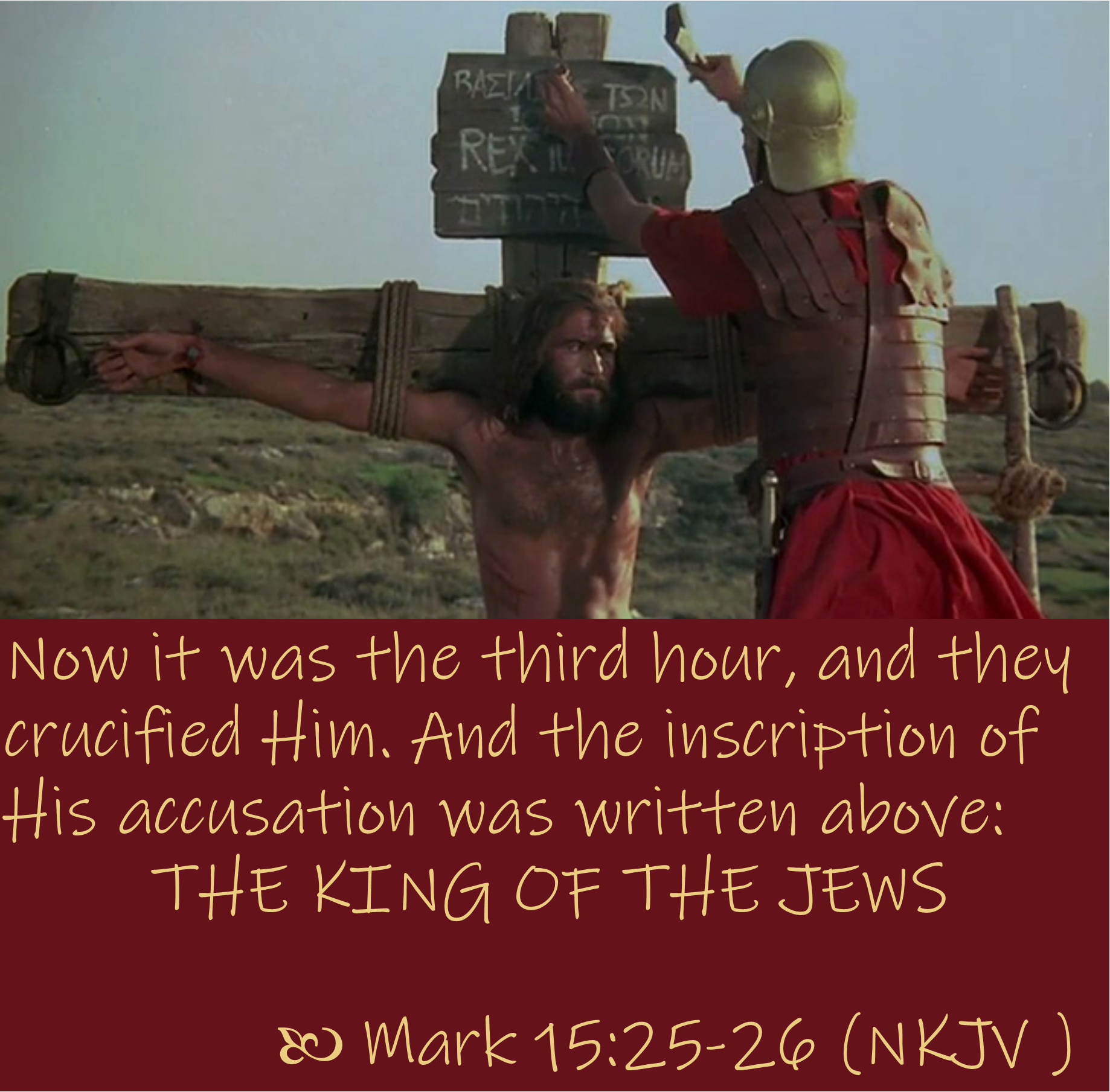
This sentencing from Pontus Pilate shows the political nature of Jesus’ crimes in the eyes of the Romans. Jesus was crucified for sedition—inciting rebellion against Roman rule.
In other words, the Roman’s weren’t executing Jesus because he claimed to be the Son of God, but rather that he claimed to be the Messiah, the King of the Jews that the scriptures had foretold. They were putting down what they saw as simply another rebellion.
Interestingly, several other Messiahs also led revolts that failed to liberate the Kingdom of Israel, and many thousands of revolutionaries were crucified. This was a brutal period, that ultimately led to the tragic destruction of the city of Jerusalem by the Romans in 70CE, resulting in the Jewish diaspora.
After Jesus’ death, this fact of his “sedition” would be actively suppressed in favor of another story. Once the Christian movement began spreading through the Roman empire, it was more convenient to place the blame of Jesus’ death on the Jews, rather than the Romans.
Notice how Pilate is portrayed in the gospels. He comes across as a compassionate and just judge who is moved by Jesus. He tries to spare his life, but his hands are tied. Its the Jewish priest class that’s to blame for the crucifixion, not innocent Pilate!
“I find no fault in him”
—Pontus Pilate, John 18:38
But when you look at the larger body of evidence, one sees a very different picture. Historical accounts show us that Pilate was a particularly brutal Roman governor who ruled with an iron fist.
Philo describes Pilate as a ruler characterized by “corruption, violence, robberies, ill-treatment of the people, executions without trial, and grievous inhumanity.”
Josephus similarly portrays him as heavy-handed and dismissive of Jewish customs, often provoking unrest through his actions.
His career as a Roman governor in Judea came to an end after a particularly gruesome massacre. Pilate violently suppressed a Samaritan gathering on Mount Gerizim, killing many participants and executing their leaders. This was so obscene, even by Roman standards, that it cost him his job.
So it’s pretty clear that Pilot was no friend of Jesus, and he was in the (almost daily) habit of crucifying Jews.
This historical and secular lens shows us the context in which Jesus lived: a politically unstable period of messianism, apocalypticism, zealotry, revolution, and utter brutality.
But most importantly, it paints a picture of Jesus the Messiah, the want to be king of the Jews who was crucified for sedition, like many Messiahs before and after him.
The Christ - Jesus the Mythic Son of God
This second lens takes the perspective of the traditional Christian worldview of the “Christic Jesus,” the Son of God. This is where we enter the magical land of myths and miracles.
Despite Messiah (Hebrew) and Christos (Greek) both literally translating to “anointed one,” the words took on very different meanings.
As previously mentioned, the Jews saw their coming Messiah as an heir of king David, a Jewish man strictly living the Jewish law, and the leader (king) of a theocratic political movement. They certainly didn’t see the coming Messiah as the literal Son of God, or the God of the old testament incarnated in the flesh.
But for Christians, Jesus isn’t any ordinary messiah. He is divinely born of a virgin, sired by God Himself, the only begotten Son. He lived a ministry of miracles, from moon-walking across water to raising dudes from the dead. He transcended the Jewish law of Moses and brought a new gospel to the world.
Most importantly, his crucifixion was the perfect (human) sacrifice to God, an atonement that redeemed the sins of all humanity. For this reason he earned the title of Savior and Redeemer, and was raised from the tomb after three days.

After his death, Jesus’s movement takes an interesting (and ultimately historic) turn. The apostles begin preaching the literal resurrection of Jesus, claiming he was raised from the dead.
Instead of the movement being smothered in its Palestinian cradle, Jesus became a divine martyr and the story spreads like wildfire.
The early days of the church are complex and mysterious, but one thing is for sure: Nobody had more of an impact on evolving and spreading the Christian story than Paul.
Paul was a tax collecting Jew who zealously persecuted the early Christians. He was involved in many arrests of Christians, approved the execution (stoning) of Christians like Stephen, and by his own word, his efforts to destroy the church were “beyond measure.”
But then a miracle happened!
While traveling on the road to Damascus, Paul met the risen Jesus and was transformed. Historians place this miraculous conversion and supernatural encounter at about 2-5 years after the crucifixion.
Paul changed his name (from Saul) and began calling himself an apostle of Jesus Christ. He began preaching his very own (very different) Christianity than the Jewish flavor coming from Jesus’s other disciples.
You see, the apostles in charge of the church after the death of Jesus were all Jewish and strictly obeyed the law of Moses. This included the required circumcision of all Jewish males. Paul crafted instead a faith-based version of Christianity, re-skinned for the gentiles of the Roman empire.
For Paul, all you gotta do is have faith in Jesus Christ, the Son of God who died for your sins and conquered death, and you (and your foreskin) will be saved.
Needless to say, this new “Pauline” Christianity caused tension between Paul and the rest of the apostles, you know, the ones who actually walked and talked with the physical Jesus, and who’s scarred penises would have made father Abraham proud.
But ultimately, it was Paul’s version that won out. The New Testament Bible contains 27 books, 13 of which are authored by Paul. That’s about half.
You see, after the Roman destruction of Jerusalem in A.D. 70, the Jewish Christian Church based there lost authority, but the Gentile Church founded by Paul spread rapidly around the Mediterranean.
Despite hardcore persecution, horrific torture, and executions, the early followers of Christianity kept the faith and fervently spread the word. The gospel quickly traveled across the empire via letters traveling down Roman roads, on the lips of slaves telling stories of the risen Lord, and via evangelists like Paul preaching in the streets.
This lens tells the story of Jesus the Christ, the divine Son of God who was sacrificed to redeem the world. It also shows Paul’s influence in the story, namely giving Jesus the title of Christ, which carried a radically different definition than that of messiah.
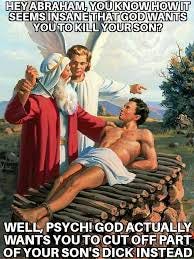
However, it can’t quite explain how the hell, after two thousand years of “progress,” we still mutilate the genitals of our baby boys. 🤦♂️
The Holy Trinity and the Nicene Creed
Those first 3 centuries of the Christian movement are complex and mysterious. Only recently (the last century) have new discoveries of ancient Christian texts from that period shined new light on what the early church was like.
There were a vast diversity of beliefs, stories, and religious practices in the early church period. Just to get the flavor of it, here are 10 of the most notable sects.
The Jesus meme was merging with all the cultures around the Roman empire, taking on various different fusions and variations.
But ultimately one version would win out and be named orthodox. In a crazy twist of events, the underdog church of persecuted Christians would transform into a Holy Empire spread around the globe.
This final lens is the last important puzzle piece for understanding the mainline Christian story, as it is the “right opinion” or the standard orthodox Christian narrative.
Orthodox comes from the Greek orthodoxos: orthos ‘straight or right’ + doxa ‘opinion’.
The first Christian Roman emperor, Constantine, spread the Pauline gospel of Christ across his empire. Christianity became the default religion of the largest empire on earth, and ultimately a meme that would spread around the planet, colonizing the minds of billions.
But first, it had to standardize. There were too many sects, heresies, and disputes about the nature of Jesus and God. These disputes would often lead to violence, exile, and execution.
So in 325 CE Constantine called a council of the major bishops around his empire. Ultimately what emerged was the standardized (orthodox) Christian doctrine. The Nicene Creed lays it all out as “The Holy Trinity”—the triune God:
We believe in one God, the Father almighty, maker of heaven and earth, of all things visible and invisible. And in one Lord Jesus Christ, the only Son of God, begotten from the Father before all ages, God from God, Light from Light, true God from true God, begotten, not made; of the same essence as the Father… And we believe in the Holy Spirit, the Lord, the giver of life. He proceeds from the Father and the Son, and with the Father and the Son is worshiped and glorified.
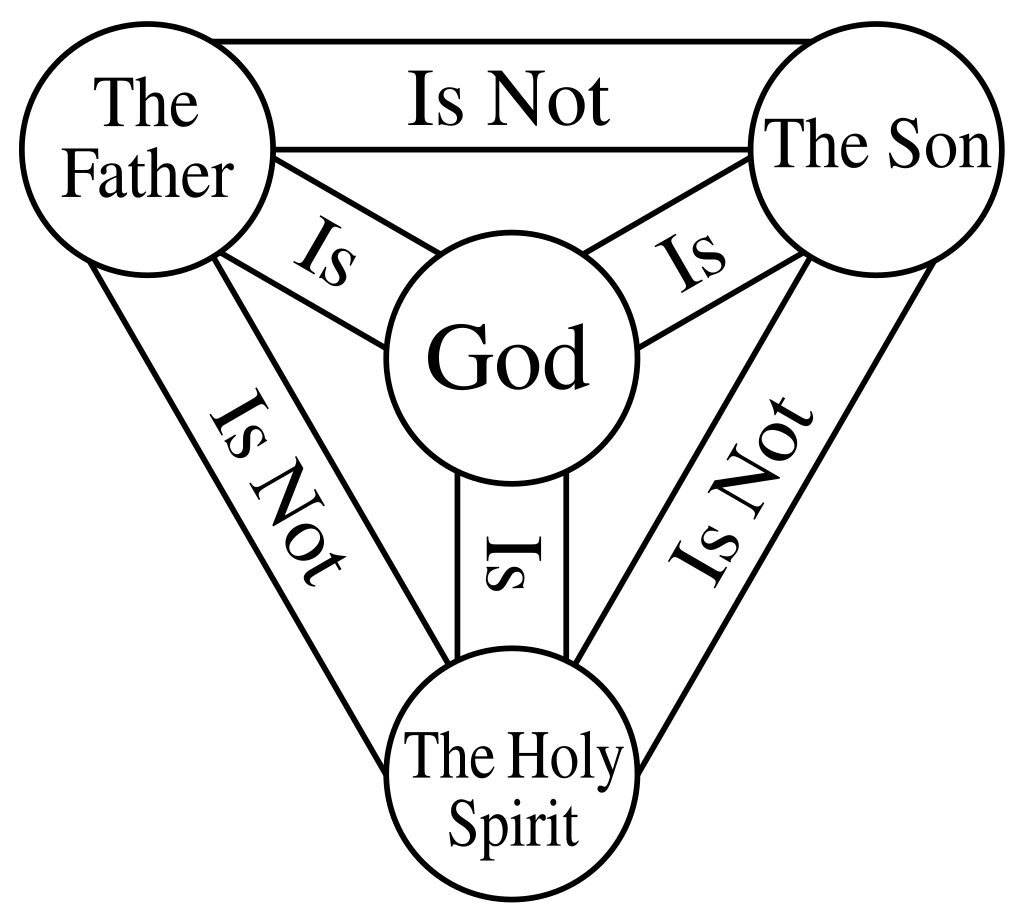
As you can clearly see, the orthodox description of the Godhead is super simple, and not confusing at all. Right? RIGHT?!
Father, Son, Holy Spirit, the all masculine God. No mental gymnastics required at all to make that a coherent thought.
I mean what kind of cosmology leaves out the feminine entirely? You know, the great mother (matter), the womb of creation, mother nature, the feminine aspect of creation, the yin principle, the goddess, etc, etc, etc.
It also makes no mention of someone really important: you. There is only ONE Son after all. No room for any other humans (or beings of any kind) in the trinity.
This is the fundamental flaw of the Christian meme (at least this orthodox version). It separates the individual from God, putting God on a lofty throne as king of the universe. All of our divinity is projected onto Jesus, the ONLY Son of God.
In this un-wholly trinity, God is the ultimate other, the supreme being to worship and revere. Your life is merely a probation, a testing ground for the next life. Your soul is on the line, and you will only be saved from destruction and hellfire (or outer darkness) if you accept Jesus as our Lord and Savior.
This paradigm of separation has fueled holy wars, inquisitions, colonization, genocide, and the ecological devastation of our planet. I’m not laying all of humanities problems on Christianity alone, but in the west, the Christian meme (and this trinity) has massively contributed to the tragic poly-crisis we find ourselves in now.
For how could we wage an all out war on nature without a creed to separate us from her?
How could we dominate the feminine for millennia without leaving her out of the cosmological story?
Of course all of this has virtually nothing to do at all with what Jesus actually taught. The teachings of Jesus (before the hierarchies and trinities) are fundamentally teachings of charity, compassion, humility, and kindness.
His was a gospel of peace: love God, and love thy neighbor as thyself.
These principles helped pave the way for human rights and civil liberties. Many would make the case that these Christian values had a major role to play in the great American experiment of individual liberty, limited government, popular sovereignty, and unalienable rights derived from a Creator.
The “Prince of Peace” showed us how to play the Infinite Game. He transcended the old law of eye for an eye, of win-lose metrics, and zero sum competition. In a paradigm of slavery and genocide, love thy enemies and turn the other cheek was a huge update to the cultural code.
Unfortunately, there were also millions of atrocities later committed in the name of Jesus because, you know, humans. But that doesn’t take away from the radical upgrade in our collective consciousness that rippled out from his teachings.
A bit later on in this post, I’ll propose an update to the trinity, and an evolution of the Christian meme. But first, some secret sauce…
Lost Gospels and Secret Knowledge
Gnosticism is a collection of religious and philosophical ideas that emerged in the late 1st century CE among Jewish and early Christian sects. It centers on the pursuit of mystical or esoteric knowledge as the path to salvation.
Gnosis is a Greek term meaning “knowledge” or “awareness,” specifically referring to spiritual or experiential knowledge rather than intellectual or theoretical understanding.
In Gnostic thought, Jesus is often seen not as a savior through his death and resurrection (as in orthodox Christianity), but as a messenger or revealer of divine knowledge. His teachings guide individuals toward enlightenment and liberation from the material world.
The standard Christian story we know today was the one written by the winners. It does not reflect the perspective of all early Christians, and anyone who dissented (like the Gnostics) risked persecution, and even their lives.
One reason the early Christian movement was so mysterious is because all the unorthodox gospels were burned. Once Constantine “converted” and Romanized the church, any alternative views were considered heresy and were silenced. Much of the history of the first couple centuries of Christianity was destroyed.
“The victors in the struggles to establish Christian Orthodoxy not only won their theological battles, they also rewrote the history of the conflict; later readers then naturally assumed that the victorious views had been embraced by the vast majority of Christians from the very beginning.”
—Professor Bart D. Erhman, Oxford University
#historyiswrittenbythevictors
And so for centuries, the orthodox view of Christianity dominated without much contest, and was driven deep into our culture’s unconscious. “The West” was built on this foundation of Father, Son, Holy Ghost—the triune, all masculine god, and everything centered around Jesus as Lord and Savior.
But everything changed in December of 1945 when two Egyptian brothers unearthed the Gnostic Gospels at Nag Hammadi, some of the oldest surviving Christian texts on the planet.
These gospels are radically different from the orthodox biblical canon that colonized the minds of billions. These ancient manuscripts give a voice to those early Christian’s who were silenced by the Catholic orthodoxy.
We don’t have time to unpack the full library, but I recommend the work of Elaine Pagles if you want to dive deeper. For now, lets take a little peek into the past and dive into the lost gospel of a Didymos named Thomas.
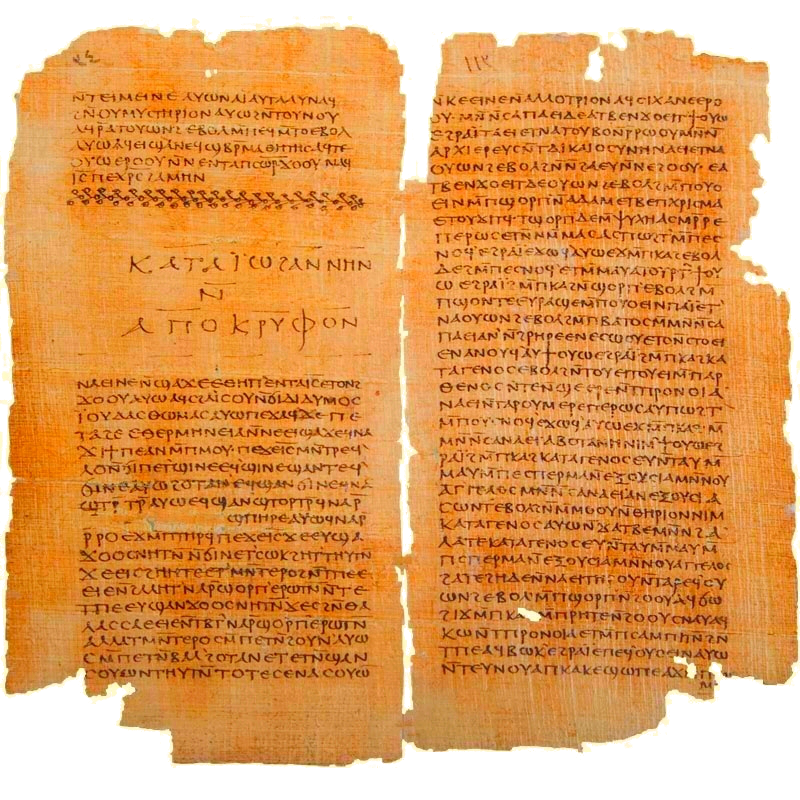
The Gospel of Thomas
Written in approximately 100-140 CE, the Gospel of Thomas gives us access to a Christian lens much different than the standard orthodox narrative.
This gospel doesn’t tell the story of the virgin birth, the ministry of miracles, or the crucifixion of Jesus. Instead, it simply contains 114 of his teachings. Its a sayings gospel.
The opening statement:
These are the hidden words that the living Jesus spoke. And Didymos Judas Thomas wrote them down.
So who was Thomas the twin? (Didymos literally means twin)
Thomas is commonly remembered as “doubting Thomas” because of John 20:24–29, where he doubted Jesus’s resurrection until he saw and touched Jesus’s wounds. After doing so, he declared, “My Lord and my God!”
However, as scholars like Pagles and others have pointed out, the Gospel of Thomas is older than the Gospel of John, and John is likely writing a polemic against Thomas.
In other words, John clearly has an agenda to debunk or refute a contemporary gospel, that of Thomas. Remember this was in the early days of the church when there were many different Christian sects, and they often didn’t see eye to eye.
John ultimately came out the victor, and his book made it into the Biblical Canon. The Gospel of Thomas was burned as heresy and was lost to the sands of time. So for nearly two millennia we only knew Thomas the doubter, but never actually got his side of the story.
But that all changed when the Nag Hammadi library was discovered, and we unearthed a lost gospel thats been uncorrupted and unchanged for 1800+ years. Now we finally get to read what John was so worked up about, and see through some lenses other than the ones “The Holy Empire” crafted for us.
Now I don’t know about you, but it seems to me like any Christian who discovered the “hidden words of the living Jesus” would be stoked. Especially if the source was empirically dated as one of the oldest Christian texts on the planet. But shockingly most Christians I ask have never read it.
So what is it all about?
After the death of Jesus, the disciples spread out to preach the gospel. Thomas traveled eastward to India and established his church there. His gospel reads like a groovy fusion of Christianity and non-dual Indian mysticism.
Saying 77:
Jesus said, “It is I who am the light which is above them all. It is I who am the all. From me did the all come forth, and unto me did the all extend. Split a piece of wood, and I am there. Lift up the stone, and you will find me there.”
This is clearly mystical metaphor. You don’t find a human inside a piece of wood when you split it open. Rather, Jesus is speaking from the non-dual awareness that there is no separation, and we all is one (Hinduism 101).
The uni-verse is seamless, and The All resides in all.
This pan-psychic perspective expands the definition of God to include and penetrate all of the cosmos. In other words, God isn’t a man on a throne in the sky, but rather the Ultimate Reality, The All, the thing that has no outside edge.
How can anything be outside of The Kingdom of God? God is in All.
Jesus acknowledges that the status quo of the time is a paradigm of separation, and that the current wisdom traditions keep people from “entering the kingdom.”
Saying 39:
Jesus said, “The pharisees and the scribes have taken the keys of knowledge (gnosis) and hidden them. They themselves have not entered, nor have they allowed to enter those who wish to. You, however, must be as wise as serpents and as innocent as doves.”
Rather than telling the story of the resurrected lord and savior of the world, this lost gospel gives us the sayings of an enlightened Zen-Jesus, reading more like mystical koans than an eschatological call to faith and repentance.
Jesus echos the Hermetic law of polarity and reconciles the paradox of dualism. He invites his friends to “enter the kingdom” of non-dual consciousness and experience true communion, not in some afterlife, but here and now.
Saying 22:
Jesus said to them, “When you make the two one, and when you make the inside like the outside and the outside like the inside… then will you enter the kingdom.”
Hopefully this has given a bit of insight into a Mystic-Christic movement that was thriving before it got all but snuffed out by the Holy Roman Empire and the orthodoxy.
If you’re a Christian, I recommend reading the Gospel of Thomas for yourself, and maybe you’ll see that Thomas wasn’t just a doubter.
Hieros Gamos - Jesus & Mary the Magdalene
In the Gnostic Gospels, Mary Magdalene isn’t just a devoted follower and key witness, she is elevated to Jesus’s most intimate disciple and spiritual authority.
The Gospel of Philip, for example, suggests that Mary Magdalene was closer to Jesus than any of the other disciples, hinting at a special bond that some interpret as a sacred marriage.
The Gospel of Mary Magdalene is a Gnostic text focusing on Mary’s role as a prominent disciple of Jesus who received secret teachings:
Peter said to Mary, Sister we know that the Savior loved you more than the rest of woman.
Tell us the words of the Savior which you remember which you know, but we do not, nor have we heard them.
Mary answered and said, What is hidden from you I will proclaim to you.
But the biggest bombshell of them all, wasn’t hiding in a clay pot in the desert at Nag Hammadi. Rather, it was hiding in plain site at the British Museum.
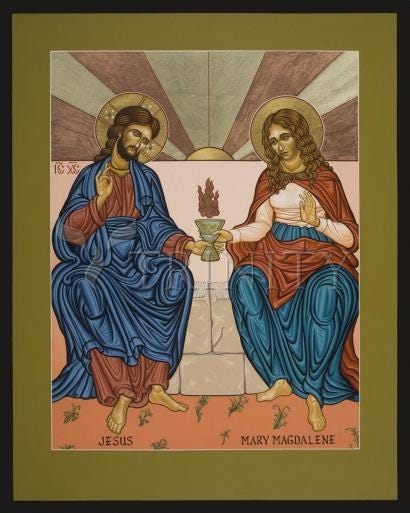
“The Lost Gospel: Decoding the Ancient Text That Reveals Jesus’ Marriage to Mary the Magdalene” is a controversial book that claims to have uncovered evidence of a secret marriage between Jesus and Mary Magdalene.
In the British Museum is an ancient manuscript from the early Church that’s at least 1,600 years old. Written in Syriac by an anonymous monk, this twenty-nine chapter document reveals an alternative narrative of Jesus’s life that challenges traditional understanding.
The important caveat here is that the authors claim the text is written in code. The characters names are actually cyphers, hiding the true identity of the stories subjects (Jesus and Mary).
This makes perfect sense when you consider that any alternative narratives about Jesus (and their authors) were being hunted down and burned during that period. So if you weren’t in the orthodox cult, and you wanted to spread the good word, you had to get crafty and hide it in plain sight.
The story is called Joseph and Asenath, but the plot of the story resembles nothing at all of the biblical story of Joseph, the son of Jacob. So clearly the names are placeholders for something else.
When scholars decoded the manuscript’s symbolism, they uncovered some wild shit:
The virgin mother Mary is replaced by the fertile and desirable bride Mary.
Jesus and Mary Magdalene were married and had two children together.
Mary Magdalene emerges as the main character of the story - a pagan priestess who led her own Christian movement.
There were assassination attempts against Jesus around 19 CE and threats to their children’s lives.
Most importantly, the text portrays a harmonious balance between masculine and feminine, and tells the story of the Hieros Gamos, the sacred wedding of the God and the Goddess.
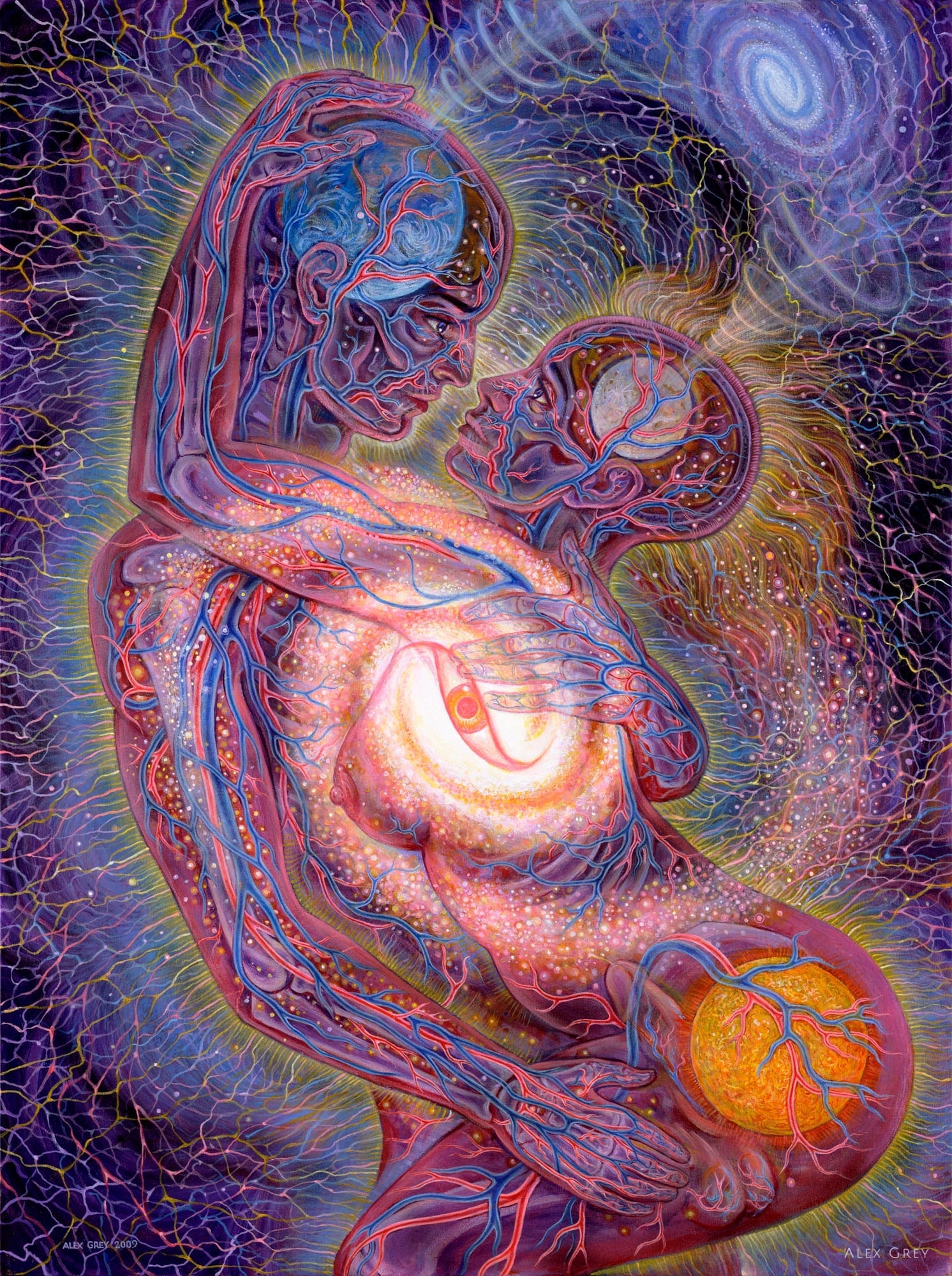
I found the book to be a fascinating perspective of an alt-Jesus who was matched by his feminine counterpart. This story is a fusion of patriarchal Judaism, and matriarchal Paganism.
It tells of the holy union of opposites in the sacred sacrament of the bridal chamber ceremony. This sacred sex between Jesus and Mary would have been the archetype for all the believing Christians who held this story as scripture.
How differently would the world look today if this was the Christianity that Constantine adopted?
Perhaps fewer witches would have burned.
The Kingdom of Heaven
I grew up believing that the kingdom of heaven was in, well, heaven. Meaning not of this Earth.
In fact, the whole point of life on this planet was to be saved by Jesus Christ, be resurrected after death, make it BACK to heaven, and ideally get into the VIP section (celestial).
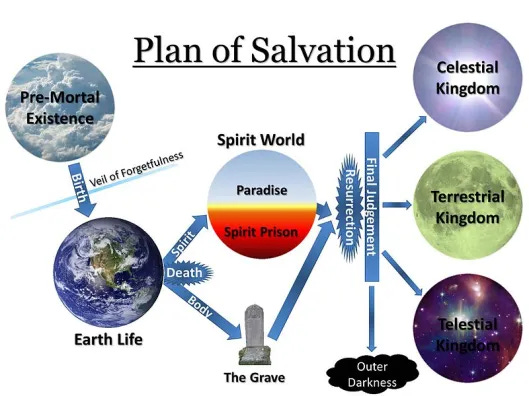
But as the Gospel of Thomas illuminates, Jesus spoke of a different kingdom.
Saying 3 from the Gospel of Thomas:
…The kingdom is inside of you, and it is outside of you. When you come to know yourselves, then you will become known, and you will realize that it is you who are the sons of the living Father. But if you will not know yourselves, you dwell in poverty and it is you who are that poverty.
The un-holy trinity is poverty.
The paradigm of separation is poverty.
To be cut off from God is poverty.
To know thyself is wealth.
To know who you REALLY are is to enter into the kingdom.
Saying 113:
His disciples said to him, ‘When will the kingdom come?’ Jesus said, ‘It will not come by waiting for it. It will not be a matter of saying “Here it is” or “There it is.” Rather, the kingdom of the Father is spread out upon the earth, and people do not see it.’
Doesn’t this sound eerily similar to all the other enlightened sages of all the ages?
“Heaven attained the One and became clear.
Earth attained the One and became fertile.
Spirits attained the One and became divine.
Valleys attained the One and became full.
All things attained the One and lived and grew.”
—Lao Tzu
“You are not a drop in the ocean. You are the entire ocean in a drop.”
—Rumi
And if you would know God be not therefore a solver of riddles. Rather look about you and you shall see Him playing with your children. And look into space; you shall see Him walking in the cloud, outstretching His arms in the lightning and descending in rain. You shall see Him smiling in flowers, then rising and waving His hands in trees.
—Khalil Gibran
“The fundamental ultimate mystery… is this: for every outside there is an inside, and for every inside there is an outside.”
—Alan Watts
Yin and Yang go together. Male and female go together. Inside and outside go together. Self and other go together.
Therefore, love thy neighbor AS thyself ;)
The Holographic Trinity
Holon: Something that is at once a whole made of parts, as well as a part of a larger whole. From the Greek “holos” meaning whole, with the suffix “-on” suggesting a part.
Reality is holographic. Holographic means the whole is present everywhere.
Every whole is made of parts, and every part belongs to a whole. This remains true at every level of the evolutionary chain, from the subatomic to the intergalactic.
The entire cosmos is contained at every point in the cosmos.
All points in space and time are connected.
“God is an infinite sphere whose center is everywhere and whose circumference is nowhere.” —Anonymous
Think of it like Russian nesting dolls - each doll contains smaller ones while being contained by a larger one. This holonic pattern of parts and wholes shows up everywhere in nature.
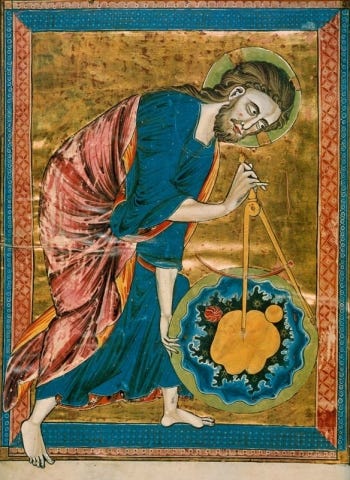
“God has created the universe after geometric and harmonic principles, to seek these principles was therefore to seek and worship God.”
—Johannes Kepler
Lets explore God and Self through this holographic lens.
An atom consists of parts called subatomic particles, is itself a complete whole, and belongs to the larger whole of the molecule.
The organelle consists of parts called molecules, is itself a complete whole, and belongs to the greater whole of the cell.
An organ consists of parts called cells, is itself a complete whole, and belongs to the greater whole of the organism.
You are yourself a whole organism, made of an infinitude of parts, and belonging to many wholes: your tribe, culture, species, planet, star, galaxy, universe. You are made of star stuff.
"The Cosmos is within us. We are made of star-stuff. We are a way for the Universe to know itself"
—Carl Sagan
Originating from eastern cosmology, Indra’s Net offers a holonic metaphor. It symbolizes the interconnectedness and interdependence of all things in the universe.
The Vedic god Indra weaves a vast, infinite net, with jewels placed at each intersecting node. Each jewel reflects all other jewels in the net, illuminating how every part of existence contains the whole.
The Uni-verse is the whole. God. The All. Brahman. Great Spirit. The unnamable ONE. Seamless, but not featureless. Full of infinite unique parts, including you.
A symphony of unique selves, all filling a niche in the great ecology of cosmos.
You are a YOU-niverse, a holonic fractal of the greater Uni-verse.
You are the God-Self, the Atman, the soul, a beautifully unique expression of the One.
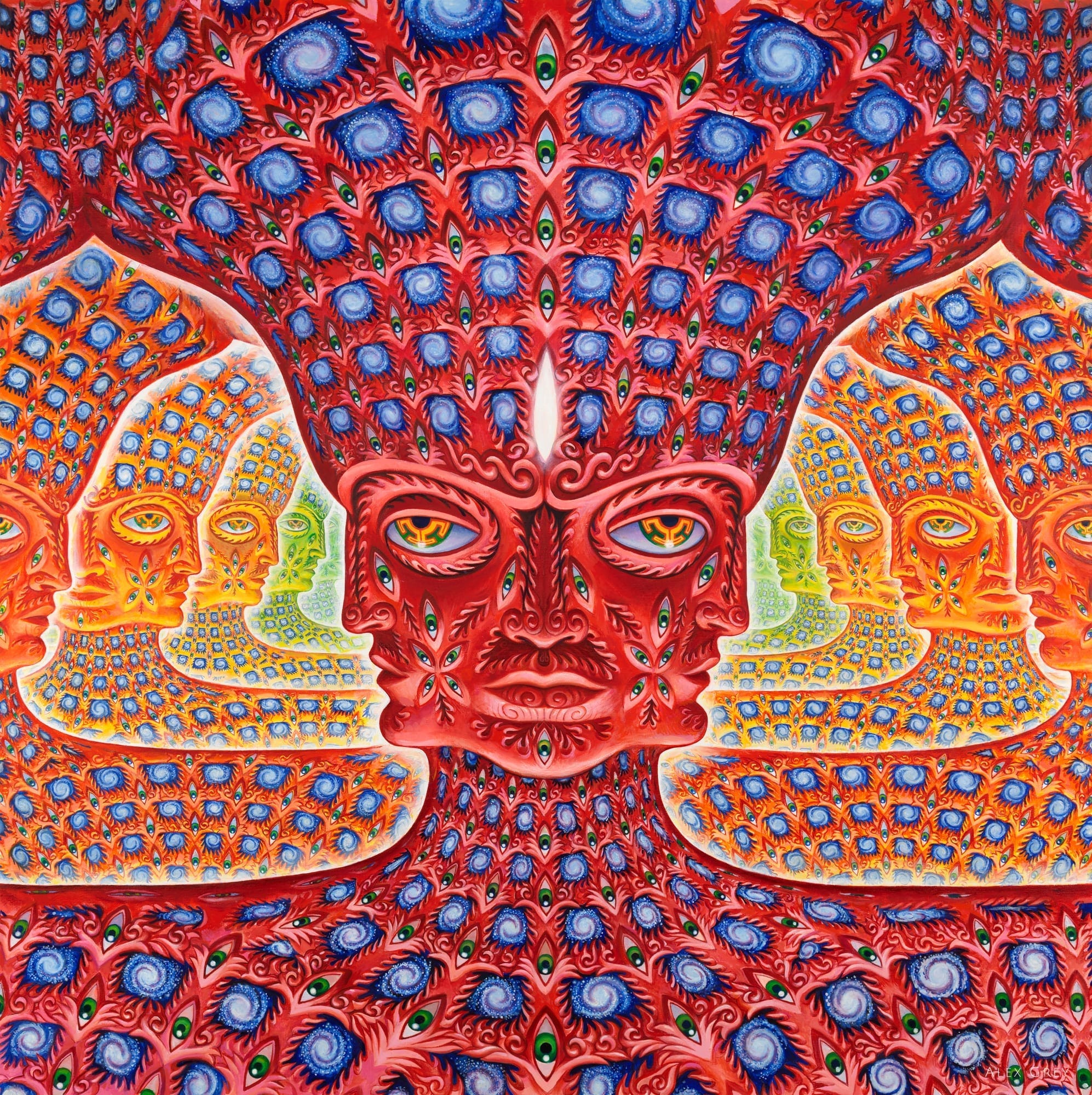
“You are an aperture through which the universe is looking at and exploring itself.” —Alan Watts
Now with our holographic lenses on, lets take another look at that Holy Trinity.
Keep in mind I’m trying to fit the infinite into a box (impossible), while keeping the same geometry as the previous trinity.
Don’t mistake my pointing finger for the moon. The map is not the territory, and all words ultimately fail when describing the Great Mystery.
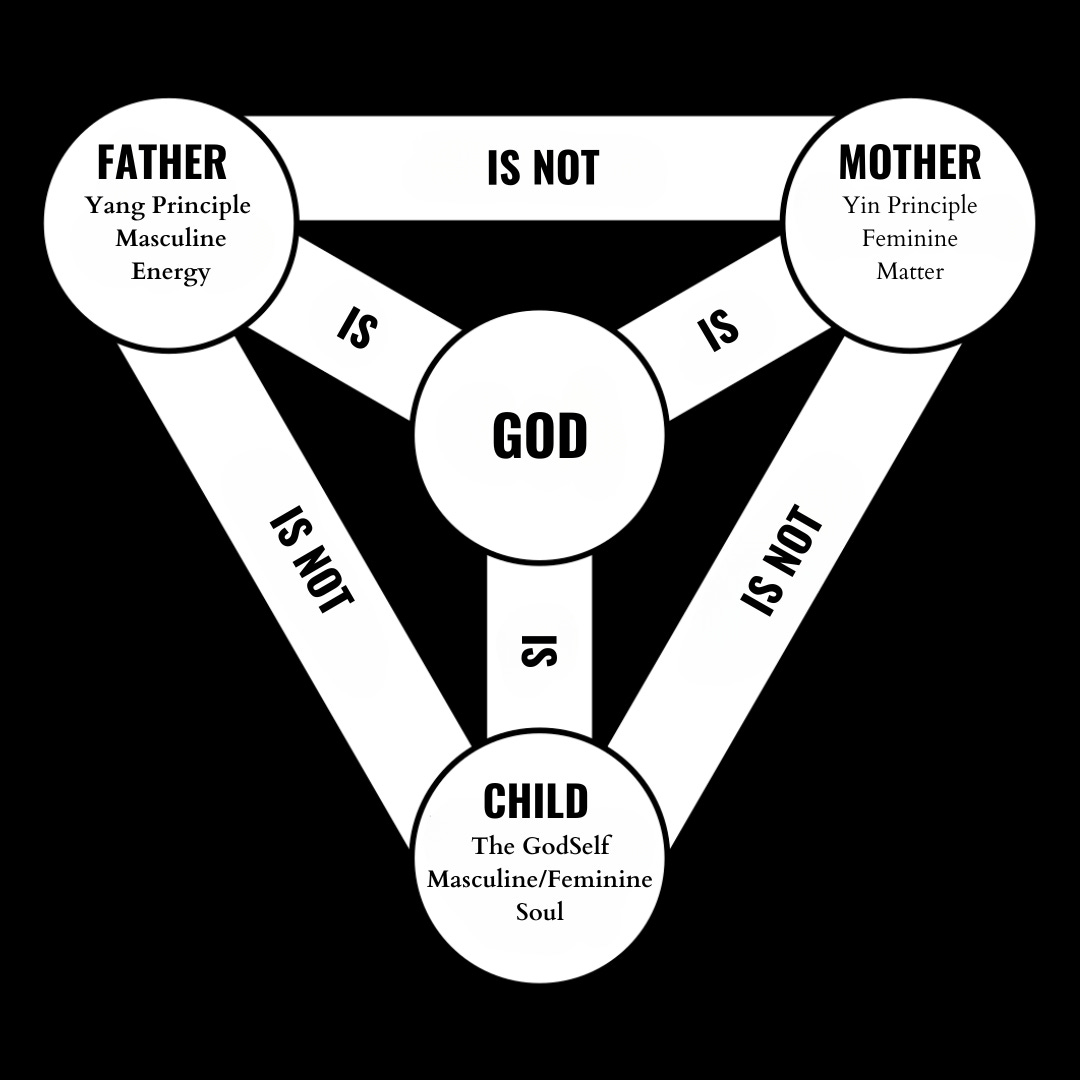
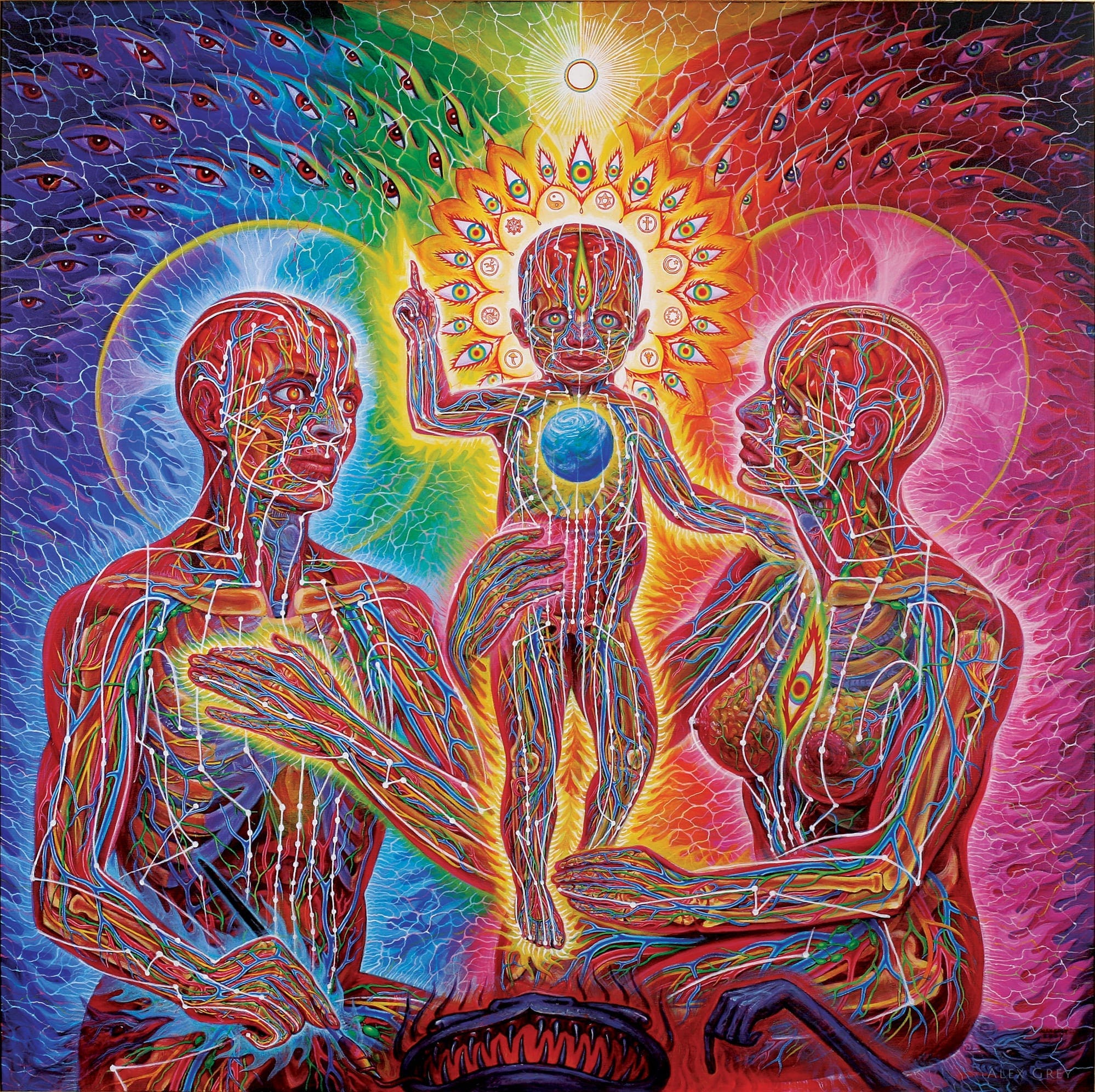
Putting on the Mind of Christ
In his book “Putting on the Mind of Christ: The Inner Work of Christian Spirituality,” Christian mystic Jim Marion makes the case that Jesus’ name is NOT Jesus Christ. Rather, Jesus “put on the mind” of the Christ, or embodied Christ consciousness.
Marion defines Christ consciousness as living in communion with God, or the perspective of the Atman, the God-Self.
Is this view, Christ is the son of God, not Jesus. Jesus of Nazareth attained the level of Christ consciousness, but he is not alone, and so can we.
To be Christ-ed then is to come home to your rightful seat in the Godhead, to belong in the Holy Trinity. It is to wake up and remember who and what we are, to dwell once more in the Kingdom of Heaven.
Thomas 108:
Jesus said, “He who will drink from my mouth will become like me. I myself shall become he, and the things that are hidden will be revealed to him.”
To be Christian is to be Christ-ed. Anointed by the truth that we are all cells in the body of Christ.
We are the ones we’ve been waiting for.
Take the man down from the cross.
Wake up.
Remember.
Much love and happy Epiphany.
Christian
Las Vegas
January 6, 2026
P.S. This is by far the longest post I’ve ever written. If you made it all the way through, thank you for your attention! I made this for you, truly. 🙏